 (208) 991-3502
 Meridian, ID






 January 30, 2026
You're ready to protect your home, but before you commit to any system, you need real numbers. Understanding home security system installation cost isn't straightforward, prices swing wildly depending...
Home Security System Installation Cost: 2026 Pricing Guide
You're ready to protect your home, but before you commit to any system, you need real numbers. Understanding home security system installation cost isn't straightforward, prices swing wildly depending on whether you're mounting a few wireless cameras yourself or hiring professionals to wire a comprehensive system throughout your property. Without clear pricing information, you risk overpaying or ending up with inadequate protection.
The security market has shifted significantly heading into 2026. Equipment prices have dropped for basic setups, but professional-grade systems with smart home integration have become more sophisticated, and their costs reflect that complexity. Monthly monitoring fees, one-time equipment purchases, and installation labor all factor into your total investment, and each decision affects both your upfront spending and long-term expenses.
At Treasure Valley Solutions, we've installed hundreds of security systems across Boise, Meridian, Eagle, and the surrounding areas since 2014. We've seen homeowners save money with the right approach and watched others waste thousands on mismatched equipment or botched DIY attempts. This guide pulls from that experience to give you accurate 2026 pricing for every type of installation, from basic starter kits to fully integrated smart security systems.
Below, you'll find detailed breakdowns of equipment costs, professional versus DIY installation expenses, and monthly monitoring rates from major providers. We'll also cover the hidden costs most guides skip and help you calculate your actual budget based on your home's specific needs.
Why home security installation cost varies so much
The gap between a $200 DIY camera kit and a $10,000 professionally installed system confuses most homeowners. Home security system installation cost depends on five major factors that compound quickly: the type and number of devices you install, whether you hire professionals, your property's layout, your monitoring preferences, and the level of smart home integration you want. Each decision multiplies or divides your total expense.
System complexity and component count
Your equipment list drives everything else. A basic setup with three wireless cameras and a doorbell costs $300 to $600 in equipment alone, while a comprehensive system with hardwired sensors on every entry point, motion detectors, glass break sensors, multiple cameras, and a central control panel runs $1,500 to $4,000 before installation. Professional-grade panels with advanced features like cellular backup and touchscreen controls add another $400 to $800 to your equipment budget.
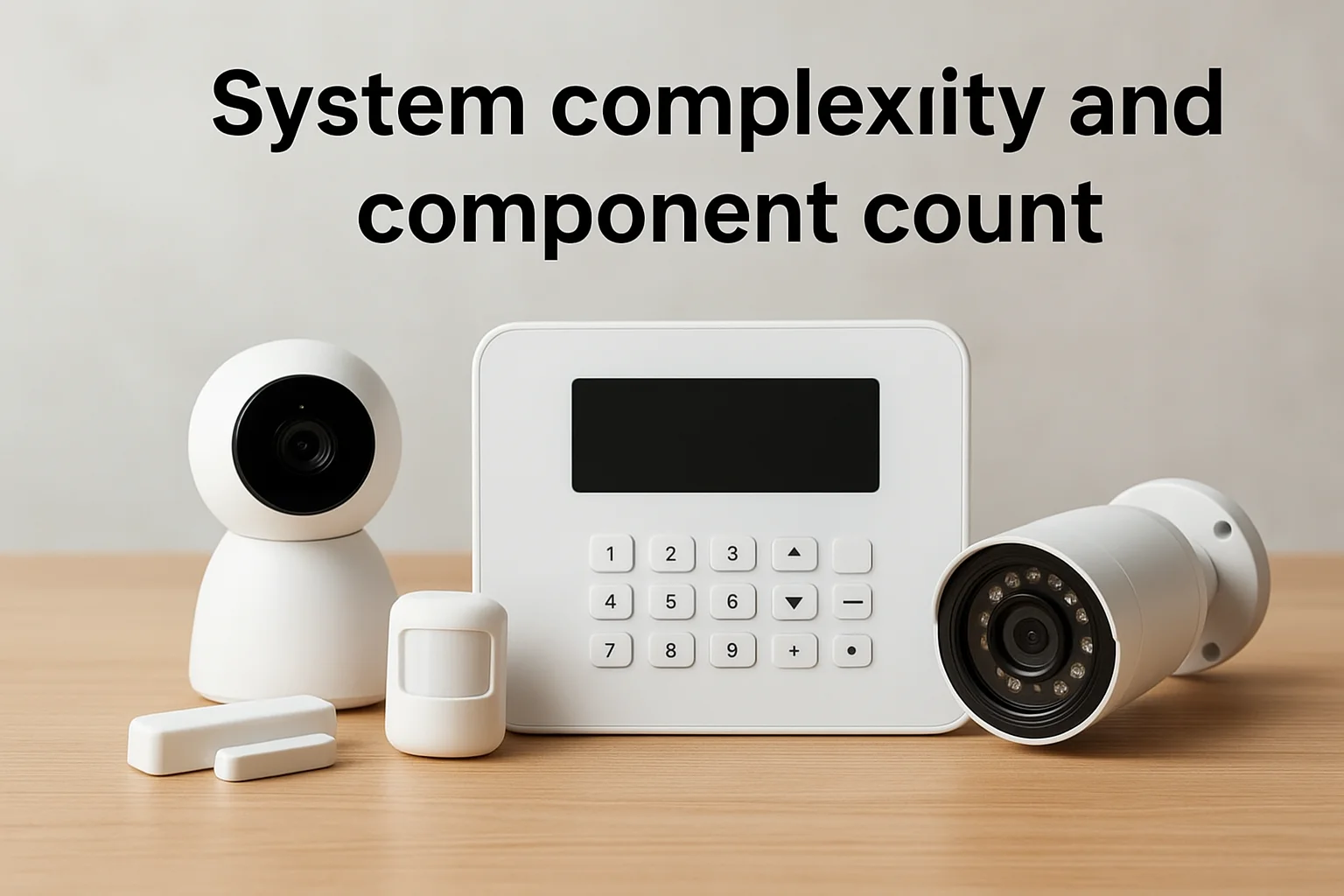
Component quality creates another pricing tier. Consumer-grade cameras from big-box retailers work for simple monitoring, but they lack the durability and features of commercial equipment. Professional security cameras with night vision, weatherproofing, and higher resolution cost $150 to $400 each compared to $50 to $100 for basic models. Sensors follow the same pattern, wireless door sensors run $20 to $40 each, but hardwired sensors with tamper detection cost $30 to $60 plus installation labor.
The equipment you choose determines not just your upfront cost but also how much you'll spend on batteries, replacements, and upgrades over the next decade.
Installation method and labor requirements
Professional installation transforms your budget. Licensed technicians charge $80 to $150 per hour in most markets, and a typical whole-home installation takes 8 to 16 hours depending on complexity. That's $640 to $2,400 in labor before you account for travel time, permits, or additional materials. Hardwired systems require fishing cables through walls, drilling, and patching, which takes longer and costs more than mounting wireless equipment.
DIY installation eliminates labor costs but creates other expenses. You'll need tools you might not own, like drills, fish tape, and wire strippers. Mistakes cost money too. Incorrectly placed sensors trigger false alarms or miss intrusions, poorly aimed cameras capture useless footage, and improper wiring creates fire hazards. Many homeowners attempt DIY installation, hit complications, and end up hiring professionals anyway, paying twice for the same job.
Property characteristics and layout challenges
Your home's construction directly impacts installation difficulty. Single-story homes with accessible attics cost less to wire than multi-story properties where technicians must cut drywall access points. Finished basements, concrete walls, and metal siding all increase labor time. Old homes with plaster walls and irregular framing take longer to wire than modern construction with standard stud spacing.
Coverage area matters too. Protecting a 1,500-square-foot starter home requires fewer sensors and cameras than securing a 4,000-square-foot property with multiple entry points. Each additional 1,000 square feet typically adds $500 to $1,200 to your total cost when you account for extra equipment and installation time. Properties with detached garages, workshops, or guest houses multiply these expenses further since you need additional cameras, sensors, and possibly separate control panels to monitor every structure.
Distance from your Wi-Fi router affects wireless systems. Cameras and sensors installed more than 100 feet from your router may need range extenders or mesh network upgrades, adding $100 to $300 to your project. Large properties sometimes require multiple hubs or panels to maintain reliable connections across the entire footprint.
2026 price ranges for equipment, install, and monitoring
Current market rates for home security system installation cost break down into three distinct categories: upfront equipment purchases, one-time installation fees, and recurring monthly monitoring charges. You'll encounter pricing tiers that reflect both the technology you choose and the level of service you want. Understanding these ranges helps you budget accurately and avoid surprise expenses after you've committed to a provider.
Equipment costs by system type
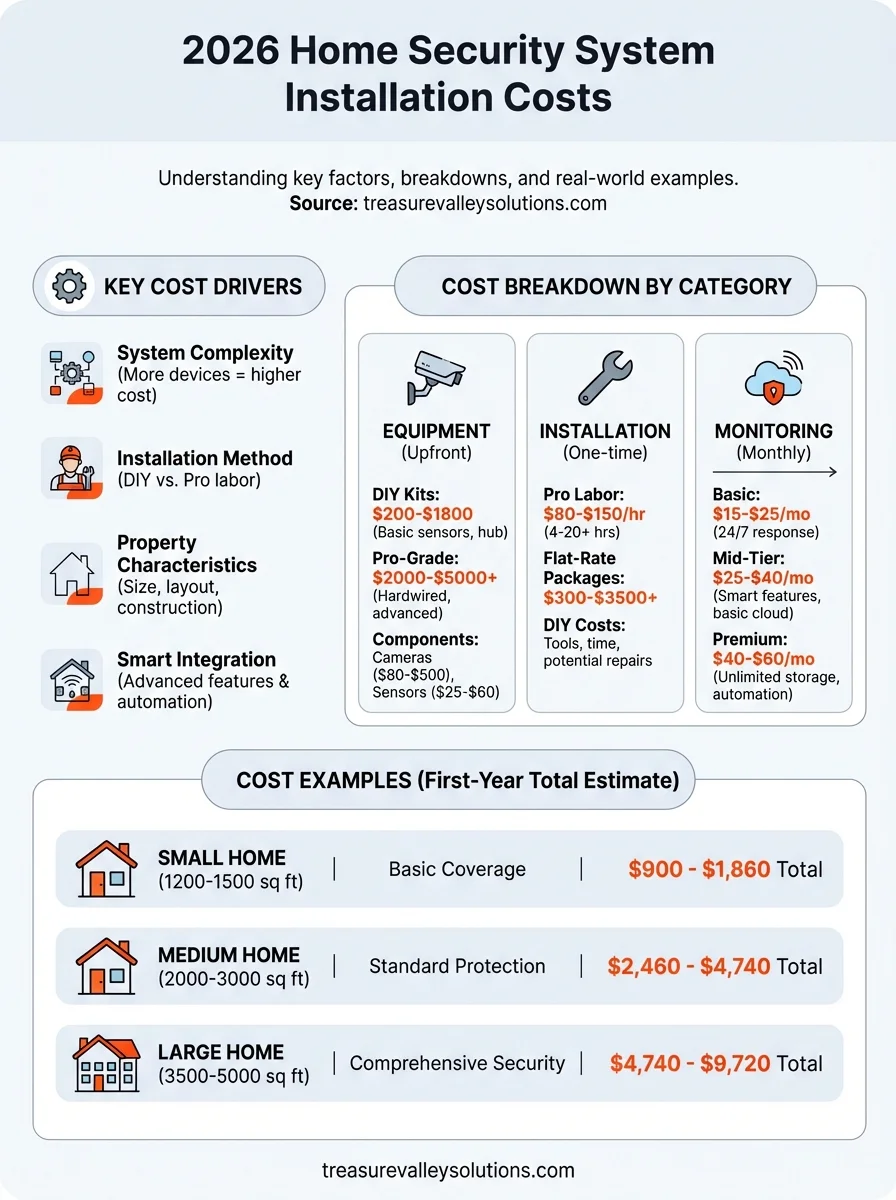
Basic DIY security kits with three to five wireless components cost $200 to $600 in 2026. These packages typically include a base station, door/window sensors, a motion detector, and sometimes a basic camera. Mid-range systems with eight to twelve devices and upgraded sensors run $800 to $1,800, offering better coverage and more reliable components that last longer under daily use.
Professional-grade equipment jumps to $2,000 to $5,000 for comprehensive protection. These systems include hardwired control panels with cellular backup, professional cameras with advanced night vision, glass break sensors, smoke and carbon monoxide detectors, and environmental monitors. High-end installations for larger homes or properties requiring commercial-grade components can reach $8,000 to $12,000 in equipment alone.
Individual components vary significantly in price. Wireless cameras cost $80 to $300 each depending on resolution and features, while hardwired security cameras run $150 to $500 per unit. Door and window sensors range from $25 to $60 each, motion detectors cost $35 to $100, and smart locks with integrated security features add $150 to $350 per door.
Professional installation labor rates
Technicians charge $80 to $150 per hour across most U.S. markets in 2026. Basic wireless system installation takes four to six hours for straightforward layouts, totaling $320 to $900 in labor. Hardwired systems require eight to sixteen hours of work, costing $640 to $2,400 depending on your home's complexity and the number of devices.
[Flat-rate installation packages](https://treasurevalleysolutions.com/blog/home-theater-installation-cost) have become more common. Some providers offer basic installation for $300 to $500 that covers mounting wireless devices and system setup. Comprehensive whole-home installations with hardwiring typically cost $1,200 to $3,500 as package deals, though complex projects requiring extensive drilling or attic access can exceed $4,000 in labor charges.
Installation complexity matters more than square footage, a two-story home with accessible attics costs less to wire than a single-story property with concrete walls and no crawl space.
Monthly monitoring fees
Professional monitoring services range from $15 to $60 per month in 2026. Basic monitoring at $15 to $25 monthly provides 24/7 professional response to alarms but may lack advanced features like mobile app control or video storage. Mid-tier plans costing $25 to $40 monthly add smart home integration and basic cloud video storage for cameras.
Premium monitoring at $40 to $60 per month includes unlimited video storage, advanced automation features, and priority response times. Some providers also charge setup or activation fees of $50 to $200 when you start service, though these are often waived during promotional periods.
DIY vs professional installation costs and tradeoffs
The choice between installing your security system yourself or hiring professionals creates a $1,000 to $2,500 swing in your upfront costs, but the real difference goes beyond that initial price gap. You'll face distinct tradeoffs in time investment, system reliability, and long-term maintenance that affect your total cost of ownership over five to ten years. Your decision should account for your technical skills, available time, and how much risk you're willing to accept with your home's protection.
DIY installation expenses and hidden costs
Your DIY path eliminates labor charges but introduces expenses most homeowners overlook. You'll need basic tools like drills, wire cutters, and stud finders that cost $100 to $300 if you don't already own them. Wireless systems seem simple until you realize you need ladder rentals for second-story cameras ($40 to $80 per day), cable management supplies ($30 to $60), and extra mounting hardware when the included screws don't match your wall type.
Installation mistakes create the biggest hidden costs. Incorrectly placed sensors trigger false alarms that result in $50 to $150 fines in many jurisdictions after your first free pass. You might drill into electrical wiring or plumbing, causing $200 to $800 in repair bills. Most significantly, poor installation means your system might fail when you need it most, and home insurance claims after break-ins sometimes face scrutiny when professionally installed systems weren't used.
Time represents another cost factor. A straightforward wireless system takes most homeowners 12 to 20 hours to install properly when you account for planning, mounting, testing, and troubleshooting connectivity issues. Hardwired systems require 30 to 50 hours of work if you're learning as you go, and that assumes you don't hit complications like hidden wall studs or insufficient attic access.
Professional installation investment breakdown
Professional installation adds $500 to $3,000 to your project depending on system complexity, but you're paying for guaranteed results and warranty protection. Licensed technicians complete in one day what takes DIYers multiple weekends, and they handle permits, inspections, and code compliance requirements that vary by municipality. Your home security system installation cost includes liability insurance, so damage during installation gets covered without touching your homeowner's policy.
Warranties provide tangible value. Professional installations typically include one to three years of labor warranty on top of equipment guarantees. If a sensor fails or a camera stops working, your installer returns at no charge during the warranty period. DIY installations void many manufacturer warranties when you damage components during setup or use incompatible mounting methods.
Professional installers optimize camera angles and sensor placement based on hundreds of previous installations, catching blind spots that DIYers discover only after break-ins occur.
Making the right choice for your situation
Simple wireless systems with five or fewer devices favor DIY installation if you're comfortable with basic home improvement tasks. You'll save $400 to $800 in labor and can complete the job in a weekend. Professional installation makes sense for hardwired systems, properties requiring ten or more sensors, or homes with challenging layouts like vaulted ceilings or stone exteriors where proper installation requires specialized equipment and expertise.
What drives your installation quote
When you request a home security system installation cost estimate, several specific factors determine whether you'll receive a quote at the lower or higher end of market ranges. Installers assess your property during site visits and calculate pricing based on concrete obstacles they'll encounter during the job. Understanding these quote drivers helps you anticipate charges before technicians arrive and explains why your neighbor's identical floor plan might cost differently.
Access and structural challenges
Your property's physical characteristics create the biggest quote variations. Installers charge $150 to $400 extra when they need to drill through brick, stone, or concrete exterior walls compared to standard wood or vinyl siding. Homes with limited attic access or crawl spaces require alternative wiring routes that add two to four hours of labor since technicians must cut drywall access panels and patch them afterward.
Ceiling height affects pricing directly. Standard eight-foot ceilings allow quick sensor and camera mounting, but vaulted or cathedral ceilings require extension ladders or scaffolding that slow installation and increase safety requirements. You'll see $200 to $500 added to quotes for homes with multiple rooms featuring twelve-foot or higher ceilings. Existing wall finishes matter too, removing and reinstalling crown molding or chair rails to run wiring behind them adds $100 to $300 to your total depending on how many rooms need this treatment.
Properties requiring outdoor trenching for detached structure coverage add $8 to $15 per linear foot to your installation quote for excavation and conduit burial.
Integration requirements and customization
Smart home integration creates additional quote line items. Connecting your security system to existing lighting controls, thermostats, or voice assistants requires programming time that runs $100 to $300 beyond basic installation. Custom automation rules like having lights flash when alarms trigger or cameras record when specific doors open add one to three hours of configuration work.
Pre-existing system removal affects pricing when you're replacing old equipment. Technicians charge $200 to $600 to properly disconnect hardwired legacy systems, remove outdated panels, and fill mounting holes. Properties with multiple old systems or damaged wiring from previous installations require extra cleanup time before new equipment goes in.
Local market factors
Your geographic location influences labor rates significantly. Urban markets with higher living costs see technician rates $20 to $40 per hour higher than rural areas. Permit requirements vary by municipality, some jurisdictions charge $50 to $200 for security system permits while others require none. You'll also pay more in regions where licensing laws create installer scarcity, reducing competition and driving up prices across all providers.
Cost examples by home type and coverage level
Real numbers make the difference between guessing and budgeting accurately. You'll see how home security system installation cost changes based on property size and protection depth when you examine specific scenarios that match your situation. These examples reflect current 2026 pricing from actual installations, giving you concrete figures to work with rather than vague ranges that don't help you plan.
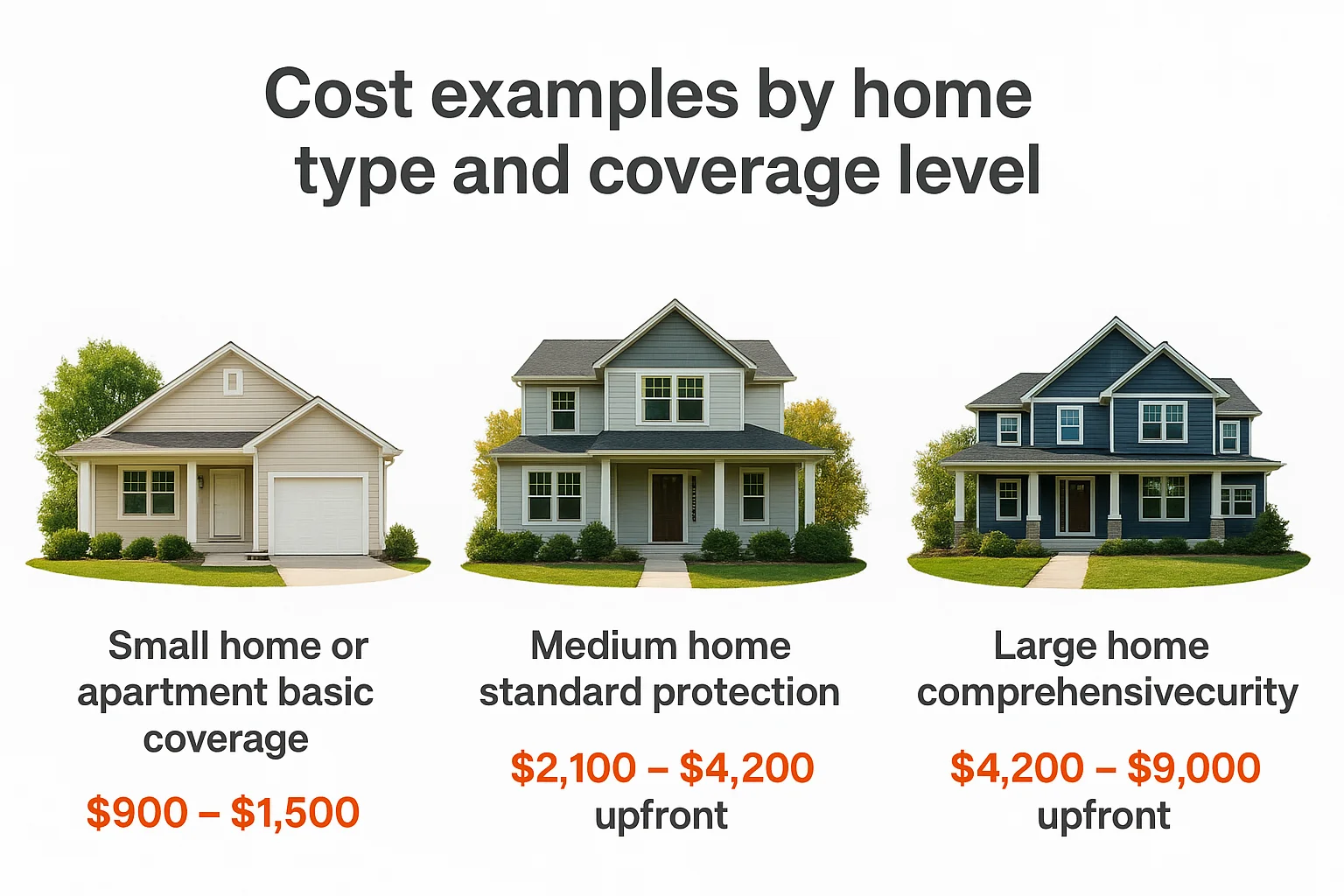
Small home or apartment basic coverage
Your 1,200 to 1,500 square foot property with one or two entry points needs minimal equipment to achieve solid protection. A basic wireless system with five door/window sensors, one motion detector, two cameras, and a control panel costs $400 to $700 in equipment. Professional installation adds $500 to $800 for the four to six hours required to mount everything and configure your system properly.
Total upfront cost lands at $900 to $1,500 before monitoring fees. Monthly monitoring runs $20 to $30 for basic professional service, bringing your first-year total to $1,140 to $1,860. You can reduce costs by $500 to $800 with DIY installation if your property has straightforward layouts without height challenges or difficult mounting surfaces.
Medium home standard protection
Properties between 2,000 and 3,000 square feet typically have three to five entry points that need sensors plus multiple rooms requiring motion detection and camera coverage. Your equipment list grows to ten to fifteen sensors, three to four cameras, two motion detectors, and an upgraded control panel with touchscreen features. Equipment costs run $1,200 to $2,400 depending on camera quality and sensor types.
Professional installation takes eight to twelve hours for proper hardwiring and optimal device placement, costing $900 to $1,800 in labor. Your total upfront investment reaches $2,100 to $4,200, with monthly monitoring at $30 to $45 adding $360 to $540 annually. First-year costs total $2,460 to $4,740 for comprehensive middle-tier protection.
Medium homes benefit most from professional installation since the increased device count and wiring complexity multiply the time DIY installers spend troubleshooting connection issues.
Large home comprehensive security
Your 3,500 to 5,000 square foot property with multiple floors and six or more entry points demands extensive coverage. Expect fifteen to twenty-five sensors, six to eight cameras covering all angles, multiple motion detectors, glass break sensors, and environmental monitors. Equipment alone costs $3,000 to $6,000 for professional-grade components that handle the larger system complexity.
Installation requires twelve to twenty hours of professional work at $1,200 to $3,000, particularly when technicians must wire multiple floors and integrate smart home features. Total upfront costs reach $4,200 to $9,000, and premium monitoring with advanced features costs $45 to $60 monthly. Your complete first-year investment totals $4,740 to $9,720 for top-tier protection across your entire property.
How to estimate your total cost before you buy
You need accurate numbers before committing to any security provider or equipment package. Estimating your home security system installation cost starts with a clear property assessment and realistic assumptions about what you actually need versus what salespeople want to sell you. Most homeowners overestimate or underestimate by $1,000 to $2,000 because they skip critical calculation steps or trust marketing materials instead of doing their own math.
Calculate your equipment needs by coverage area
Start by mapping every door, window, and vulnerable area in your home. Count all entry points including basement windows, garage doors, and sliding glass doors that need sensors. Multiply your entry point count by $30 to $60 per sensor for a baseline equipment figure. Add $150 to $400 per camera for the number of cameras you need, focusing on main entries, driveways, and backyards rather than covering every possible angle.
Your square footage determines additional components. Properties under 2,000 square feet typically need one to two motion detectors at $35 to $100 each, while larger homes require three to four units to cover all living spaces effectively. Include your control panel cost of $200 to $800 depending on features, plus $150 to $350 per smart lock if you're upgrading door hardware as part of your security installation.
Add installation labor to your budget
Professional installation runs $80 to $150 per hour in most markets, so estimate the time your project requires. Wireless systems with ten or fewer devices take four to six hours, costing $320 to $900 in labor. Hardwired installations with fifteen to twenty-five devices require twelve to twenty hours at $960 to $3,000 total. Add $200 to $500 extra if your home has difficult access, concrete walls, or requires extensive wiring through finished spaces.
You can request installation quotes from three local providers and average them to get your most accurate labor estimate before purchasing any equipment.
Factor in long-term monitoring costs
Monthly monitoring fees accumulate quickly over your system's lifespan. Multiply your $20 to $60 monthly rate by 12 months, then by the number of years you plan to keep the system. A five-year commitment at $30 monthly adds $1,800 to your total cost. Include potential annual increases of 3% to 5% that most providers implement, raising your actual five-year monitoring cost to $1,900 to $2,000 when you account for price adjustments over time.
Ways to lower costs without lowering protection
You can cut 30% to 50% off your total security system expenses without compromising your home's safety. Smart cost reduction focuses on eliminating waste and inefficiency rather than skimping on critical components. Your home security system installation cost drops significantly when you prioritize essential coverage areas first, buy equipment strategically, and negotiate service contracts that match your actual needs instead of accepting default packages.
Focus on critical zones first
Your entry points and main living areas deserve protection before you add cameras covering every square foot of your yard. Install sensors on all ground-floor doors and windows plus basement access points, then add cameras only at your front door, back door, and garage. You'll spend $800 to $1,500 on this core setup compared to $3,000 to $5,000 for comprehensive coverage, yet you're protecting the most likely breach points where 90% of break-ins occur.
Wireless equipment in critical areas performs as well as hardwired systems for most homes while cutting installation costs by $500 to $1,200. Modern wireless sensors have five to seven-year battery lives and transmit reliably within 300 feet of your base station. You only need hardwired components in areas with thick walls, metal interference, or where you want completely maintenance-free operation.
Buy equipment separately from monitoring
Purchasing your own equipment and choosing monitoring separately saves $400 to $1,000 compared to provider-bundled packages. You'll find identical sensors and cameras on Amazon for 20% to 40% less than what installation companies charge in their packages. Bring your own equipment to installers who offer labor-only quotes, typically $600 to $1,200 for comprehensive installation without markup on components.
Month-to-month monitoring contracts cost slightly more than annual agreements but let you switch providers when better rates appear. You'll pay $5 to $10 extra monthly but avoid $200 to $500 cancellation fees that locked contracts impose when you find cheaper service elsewhere.
Equipment purchased during Black Friday or Cyber Monday sales typically costs 30% to 50% less than regular pricing, cutting $300 to $800 off your total project cost if you plan ahead.
Negotiate installation timing and scope
Installers offer $200 to $400 discounts during slow winter months or when you schedule multiple weeks in advance. Ask about price matching if you've received competing quotes, most companies drop their labor rates by 10% to 15% rather than lose jobs to competitors. Request itemized quotes that separate equipment from labor so you can negotiate each component individually instead of accepting package pricing.
Next steps
You now have the pricing framework to budget your security installation accurately. Armed with specific equipment costs, installation rates, and monitoring fees for 2026, you can approach providers with confidence and spot overpriced quotes before signing contracts. Understanding home security system installation cost helps you avoid both overspending on unnecessary features and underinvesting in critical protection zones around your property.
Your next move depends on where you stand. Request detailed quotes from three local installers if you're ready to move forward, making sure each proposal breaks down equipment and labor separately. Compare those numbers against the ranges covered in this guide to identify fair pricing. Properties requiring complex hardwired systems or smart home integration benefit most from professional assessment since your unique layout creates variables that generic estimates can't capture.
Contact Treasure Valley Solutions for transparent pricing on your specific property in the Treasure Valley area. We've installed security systems across Boise, Meridian, and Eagle since 2014, and we provide itemized quotes with no hidden fees that show exactly where your money goes.